
The Highest Offer Isn't Always the Best Offer: The New Rules of Real Estate Negotiation
I had a seller ask me a question a few months ago that's stuck with me ever since:
"Why would I take the lower offer?"
She had two contracts on her kitchen table. One was $5,000 higher than the other. On paper, the choice looked obvious. But once we walked through both offers line by line — financing, contingencies, timeline, the buyer's actual readiness to close — the "lower" offer turned out to be the smarter one to accept. She took it. And a month later, when the higher offer's buyer hit a financing snag on a different deal I heard about through the grapevine, she was glad she did.
That conversation is really what this whole article is about.
For years, buyers and sellers have circled around one question:
What price can we agree on?
Price still matters — a lot. But after eighteen years of sitting at closing tables, I can tell you it's rarely the only thing that matters, and sometimes it isn't even the thing that matters most.
Today, a good negotiation might touch on:
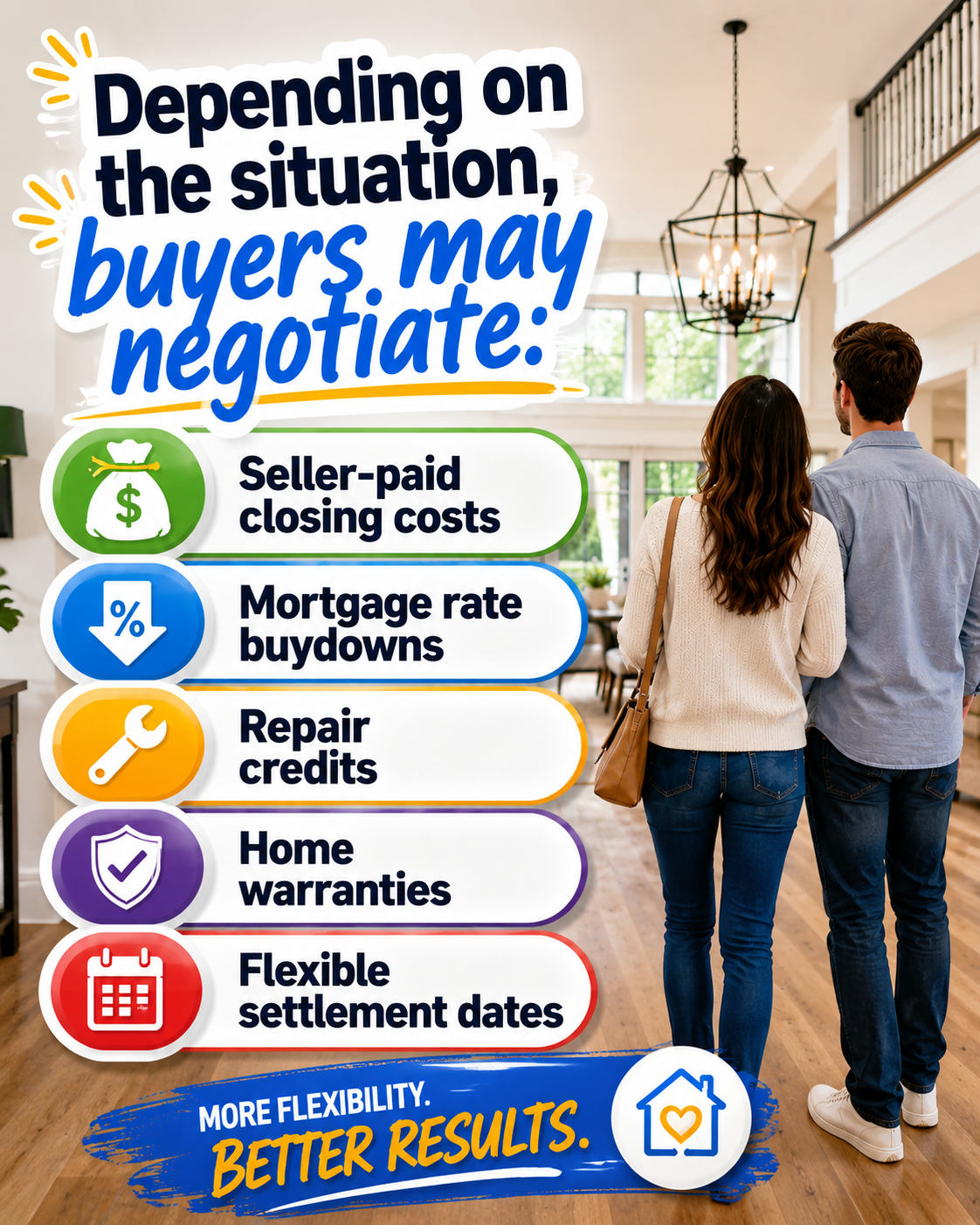
Seller-paid closing costs
Mortgage-rate buydowns
Repair credits
Home warranties
Settlement dates
Inspection terms
Appraisal protections
Financing contingencies
Possession dates
Personal property
Earnest-money deposits
A handful of other contract terms
Depending on what a buyer or seller actually needs, any one of these can end up being worth more than a few thousand dollars off (or on) the price. The best deal isn't the one with the biggest number at the top of the contract. It's the one that gives everyone involved the right combination of value, certainty, affordability, and peace of mind.
Why I Tell Buyers Not to Fixate on Price Alone
Let's say you're buying a $500,000 home, and the seller has some room to negotiate. You've basically got two paths:
Ask for $10,000 off the price.
Ask the seller to put $10,000 toward your eligible closing costs.
Most people's gut says take the price cut. Who doesn't want to pay $10,000 less?
But here's the thing — I run these numbers for buyers all the time, and the monthly difference is smaller than people expect.
Using a simplified 30-year loan, 10% down, and an illustrative 6.5% rate: a $500,000 purchase gives you a loan around $450,000. Drop the price to $490,000 with the same down payment, and your loan is roughly $441,000.
The difference in your monthly payment? About $57.
That's not nothing, and the price cut still helps — smaller loan, less interest over the life of the mortgage. I'm not knocking it. But I've watched more than one buyer get so focused on shaving the price that they nearly drained their savings getting to the closing table, when a credit toward closing costs would have solved their actual problem.
The CFPB backs this up — seller credits can meaningfully reduce what you need in cash at closing, though they also note you may end up paying for that credit indirectly through a slightly higher agreed price, so it's worth looking at the whole picture.
A $10,000 credit toward closing costs could mean you:
Keep more in the bank
Protect your emergency fund
Cover moving costs without stress
Buy the appliances or furniture you actually need
Fund a few improvements after you move in
Avoid raiding a 401(k) or investment account
Show up to closing needing less cash
If your income is solid but your cash on hand is tight, that $57-a-month savings probably isn't going to change your life. Having an extra $10,000 in your pocket the week you move in might.
My Advice to Buyers: Figure Out What's Actually Squeezing You
Before you write an offer, I always ask my clients to sit with one question:

What's actually making this purchase hard?
Is it:
The size of the monthly payment?
The cash you need on settlement day?
A repair you're dreading?
The cost of the move itself?
Needing to sell your current home first?
The timing not lining up?
Worry about an aging roof or HVAC system?
The risk of the appraisal coming in low?
Once you can name the real obstacle, you can build an offer around solving that problem — instead of just doing what everyone else does.
Asking for a lower price doesn't help much if your real issue is cash at closing. And asking for closing-cost help won't move the needle if what actually keeps you up at night is the size of your payment fifteen years from now. Good negotiation starts with knowing which problem you're actually trying to fix.
To My Seller Clients: Look at Your Net, Not the Line Item
I get it — when a seller sees a $10,000 closing-cost credit written into an offer, the first reaction is almost always the same:
"They want me to hand over $10,000?"
I understand the instinct. But it's not the most useful way to look at it.
The question I want you asking instead is:
What am I actually going to walk away with?
Your proceeds depend on a lot more than the sale price:
Purchase price
Seller-paid closing costs
What's left on your mortgage
Property taxes
Transfer and recordation charges
Repairs
Commissions and fees
A home warranty, if you're offering one
Other agreed-upon credits
Run the math and a $500,000 offer with a $10,000 credit often nets out about the same as a clean $490,000 offer. But those two offers aren't necessarily equal in every other way — one buyer might have rock-solid financing, a bigger down payment, fewer contingencies, or a closing date that fits your plans better. That's why I always tell my sellers: look at the whole contract, not just the number at the top.

One Thing to Know About Seller Contributions
Sellers can't just hand over any amount, either. What you're allowed to contribute depends on the buyer's loan type, occupancy, down payment, loan-to-value ratio, appraised value, and the lender's own rules.
For conventional loans, Fannie Mae and Freddie Mac both set limits on interested-party contributions — generally based on the lower of the sale price or appraised value, along with factors like occupancy and loan-to-value. If a credit ends up exceeding what's eligible or allowed, it typically can't just be handed to the buyer as cash — it has to be adjusted according to the lender's guidelines.
This is exactly why I always want the buyer's lender reviewing any proposed credit before we finalize a contract. It saves everyone a headache later.
Rate Buydowns: A Tool More Buyers Should Know About
There's another negotiating lever I've been using with clients a lot more in recent years: the mortgage-rate buydown.
Instead of putting money toward a lower price, that same money goes toward a lower interest rate. There are two main flavors.
The Permanent Buydown
Here, you pay discount points (or other eligible funds) at closing in exchange for a lower rate that sticks with you for the life of the loan.
Per the CFPB, one point generally runs about 1% of your loan amount — but there's no fixed formula for exactly how much your rate drops. That depends on your lender, the loan product, and market pricing at the time.
I usually recommend a permanent buydown to buyers who:
Plan to stay put for a long time
Expect to hold the mortgage long enough to make the upfront cost worth it
Want the lowest possible long-term payment
Aren't planning to refinance anytime soon
Have the cash — or seller help — to cover it
Before you commit, though, I want you to know your break-even point.
Doing the Break-Even Math
Say a buydown costs $6,000 and saves you $100 a month.
$6,000 ÷ $100 = 60 months
That's five years before the upfront cost pays for itself. If you sell or refinance before then, you've left value on the table.
The Temporary Buydown
This one lowers your effective payment for the first year or two, then steps up to the full note rate.
A 2-1 buydown, for example, might knock two percentage points off your rate the first year and one point off the second, before settling at the full rate for the rest of the loan. Fannie Mae has specific requirements around eligible temporary buydown structures, so your lender will walk you through what's allowed.
I like this option for buyers who are juggling a lot in year one — moving costs, new furniture, childcare changes, home projects, maybe overlapping payments on two properties. It buys you breathing room while you get settled.
Just don't let a temporary buydown talk you into a home you can't actually afford once the full payment kicks in. That's a mistake I've seen bite people, and I'd rather steer you away from it now.
Price Cut vs. Rate Buydown — Side by Side
Here's a comparison I like to walk buyers through.
Say you're financing $450,000. At an illustrative 6.5%, your principal-and-interest payment lands around $2,844 a month. Drop that rate to 6%, and you're at roughly $2,698 — a difference of about $146 a month.
Compare that to knocking $10,000 off a $500,000 price with the same down payment and rate, which saves you around $57 a month.
That doesn't mean the buydown always wins — the cost of the points, your loan amount, how long you'll stay in the home, and your refinance plans all factor in. But it's a good reminder not to assume the price reduction is automatically your biggest win. Sometimes it isn't.
We're All Shopping by Payment Now, Not Just Price

Something I've noticed shift over the last few years: most of my buyers aren't shopping by price anymore. They're shopping by the monthly number they can actually live with.
That number includes:
Mortgage principal and interest
Property taxes
Homeowners insurance
Mortgage insurance, if applicable
HOA dues
Special assessments
Utilities
Ongoing maintenance
Two homes priced identically can carry very different monthly costs. One has steep property taxes. Another requires mortgage insurance. A third comes with a hefty HOA fee. I always tell clients: compare the total monthly obligation, not just the sticker price — it changes the picture more often than you'd think.
Sometimes Timing Beats Money
Buyers often assume every seller wants to close as fast as humanly possible. That's not always true — and it's one of the most overlooked levers in a negotiation.
A seller might need extra time to:
Close on their next home
Wait out new construction
Relocate for a job
Work around the school calendar
Finish packing
Line up temporary housing
Settle an estate
Coordinate a tenant moving out
Wrap up repairs
Manage a divorce or other family transition
Other sellers need the opposite — a vacant property is costing them money every single day in mortgage payments, utilities, insurance, lawn care, and upkeep. For that seller, a fast, reliable closing might matter more than an extra few thousand dollars.
That's why I'll often have a buyer's agent simply ask: does the seller have a preferred settlement date, or any timing concerns we should know about? The seller doesn't owe anyone details, but even a general answer can help us write an offer that actually fits their life — no price increase required.
The Winning Offer Solves the Seller's Real Problem
I've watched this play out more times than I can count.
Offer A: $510,000, thin down payment, shaky financing, several contingencies, a closing date that doesn't work for the seller, and a long wish list of items they want included.
Offer B: $505,000, strong financing, funds already verified, reasonable contingency windows, a closing date that fits the seller's plans, and far less uncertainty.
Offer A is $5,000 higher. It's also, in my experience, often the weaker offer — because an offer that falls apart before closing is worth nothing at all. Sellers have to weigh the odds that a deal actually reaches the finish line, not just the number on the page.
What I Look at in Every Offer, Not Just the Price
Financing Strength
Is the buyer truly pre-approved, with income, assets, credit, and debt verified — not just a quick online form? Is that pre-approval recent? Is the lender someone I know responds quickly? Does the loan type suit the property? Does the buyer have enough for the down payment, closing costs, and reserves?
Contingencies
Financing, appraisal, inspection, sale of another home — how many are in play, how long do they stay open, and what can the buyer walk away from?
Earnest Money
How much is being offered, when does it arrive, and under what conditions could it come back to the buyer?
Timeline
Settlement date, inspection window, financing deadline, appraisal timing, possession date.
Requested Concessions
Closing-cost help, a home warranty, personal property, repairs — and what's the seller's actual net after all of it?
Probability of Closing
This, more than anything, is what I'm really evaluating. Does this buyer have the financing, the motivation, and the flexibility to get all the way to the closing table?
Inspections: A Chance to Solve Problems, Not Reopen Negotiations
A home inspection gives the buyer a clearer picture of what they're actually buying. Depending on the findings and the contract, that can open the door to negotiating repairs or other solutions.
I used to see buyers hand over long repair lists routinely. It rarely goes well. The seller ends up hiring the cheapest contractor available, picking materials the buyer wouldn't have chosen, rushing the work under time pressure, or just feeling overwhelmed on top of everything else involved in moving.
More often now, I steer clients toward a repair credit instead. It lets the buyer choose their own contractor, pick their own materials, schedule the work on their own timeline, and even fold it into a bigger renovation down the road.
That said, credits aren't always an option — health, safety, structural, appraisal, or lender-required repairs often need to be handled before closing, and some loan programs restrict how credits can be used. This is a conversation for the whole team: buyer, seller, agents, lender, and settlement company.
My advice to buyers: don't turn the inspection into round two of price negotiations. Focus on what really matters — safety hazards, active leaks, structural issues, major systems on their last legs, serious electrical or plumbing problems, environmental concerns, expensive surprises. A long list of cosmetic nitpicks tends to do more damage to goodwill than it's worth.
My advice to sellers: don't assume every inspection request is unreasonable. Look at how serious the issue really is, what it would cost to fix, whether it could affect financing or insurance, whether the next buyer would find the same problem, and what solution — repair, credit, or price adjustment — makes the most sense for everyone.
When a Home Warranty Actually Helps
If a home has some age on its systems and appliances, a home warranty can offer real peace of mind. Depending on the plan, it may cover certain failures in heating, air conditioning, plumbing, electrical, kitchen appliances, water heaters, and more.
It's not homeowners insurance, and it's no substitute for a proper inspection. Coverage limits, exclusions, deductibles, and service fees vary a lot from plan to plan — I always tell clients to read the actual contract, not the glossy brochure.
For some buyers, a warranty takes the edge off worrying about a surprise repair bill in year one. For others, that same money is better spent elsewhere. It depends on your situation.
Don't Overlook Appraisal Terms
A lender typically orders an appraisal to confirm the home is worth what's being financed against it. If that number comes in under the purchase price, the deal may need to be restructured — through a seller price reduction, a bigger buyer down payment, splitting the difference, an appraisal reconsideration, revised concessions, different financing, or in some cases, cancellation.
I always want buyers to fully understand the appraisal language in their contract before agreeing to waive or limit those protections. And sellers should know that the highest offer isn't necessarily the strongest one if the price is well above what comparable sales support and the buyer has little cushion to cover a gap.
Buyers: Ask for What You Need, Not Everything You Can
I understand the temptation to ask for it all — lowest price, maximum closing help, a rate buydown, every repair on the list, a warranty, the furniture, a flexible closing date, extra contingencies. But an offer that asks a seller to solve every possible problem at once is often the offer that gets passed over.
Before you write your offer, sit with these questions:
What do I truly need?
What would be nice, but isn't essential?
What can I handle myself after closing?
Which request gives me the biggest financial benefit?
Which requests might make my offer less competitive?
Strong negotiation isn't about the longest wish list. It's about knowing what actually matters to you and asking for that, clearly.
Sellers: Do the Math Before You Say No to a Concession
Please don't reject an offer just because it includes a concession before you've run the numbers. Compare offers side by side — gross price, closing costs, expected repairs, warranty cost, other credits, mortgage payoff, transaction expenses, expected proceeds, closing date, financing strength, contingency risk, appraisal risk, and the likelihood the deal actually closes.
The highest price on paper doesn't always produce the highest net. And the offer with the best net doesn't always win if it's carrying too much uncertainty.
How I Tell Buyers to Get Ready to Negotiate
Get a real pre-approval. Not a five-minute online form — one where the lender has actually reviewed your documents and can tell you what's been verified.
Ask your lender to run the scenarios. A price reduction, a closing-cost credit, a permanent buydown, a temporary buydown, different down payments, different loan programs. Compare the monthly payment, cash to close, total cost, and break-even point for each.
Keep some cushion. Don't put every available dollar toward the down payment and closing costs — homeownership has a way of bringing unexpected expenses right out of the gate.
Understand your contract. Know exactly what your contingencies protect, when they expire, and what happens to your deposit if things don't work out.
Decide what matters to you before emotions take over. This is easier said than done, but it's the single best thing you can do for yourself.
How I Tell Sellers to Get Ready to Negotiate
Know your net at a few different price points — before an offer ever lands on your table, not after.
Get clear on your ideal timeline, both for settlement and for when you actually need to be out.
Deal with major issues before you list. A pre-listing inspection can surface problems before they become negotiation landmines.
Understand how different financing types might affect your sale — conventional, FHA, VA, and others all come with their own quirks.
Think through which concessions you'd consider. You don't need a final answer in advance, but knowing your boundaries lets you respond quickly and with confidence when an offer comes in.
Negotiation Isn't About Beating the Other Side
The best negotiations I've been part of were never about winning. The buyer wants a home on terms they can afford and live with. The seller wants to transfer the property and walk away with proceeds and terms they're comfortable with. Those two goals usually don't have to fight each other.
The buyer gets help with closing costs. The seller keeps the price intact. The buyer gets a lower payment through a rate buydown. The seller gets the closing date they needed for their own move. The buyer accepts a repair credit. The seller doesn't have to manage a contractor while packing boxes.
Nobody needs to win every single line item. Both sides just need an agreement they're genuinely willing — and able — to see through to closing.
The Question I Want You Asking Instead
It's no longer just:
What price can we agree on?
It's:
How do we structure this so it actually accomplishes what matters most to each of us?
The best deal isn't always the lowest price. The best offer isn't always the highest one. The best agreement is the one that brings together the right mix of financial benefit, affordability, certainty, timing, convenience, protection, acceptable risk, and — maybe most important of all — a real probability of getting to the closing table.
Every buyer, every seller, every property, and every loan is different. Before you negotiate concessions, credits, repairs, or financing terms, talk it through with your real estate agent, lender, settlement company, and — where it matters — a tax, legal, or insurance professional too.
Want to keep learning about how to buy, sell, and negotiate smart in this market? Come find me at MDREProsBlog.com.
I'm Mark Hewitson with Maryland Real Estate Professionals, and helping you build the right strategy for your next move is genuinely what I love doing.
And as always — if you know anyone thinking about buying or selling, I'd be honored if you sent them my way.
Hakuna Matata — it means no worries for all your real estate days.
Coming Next Week
The Biggest Mistakes Buyers Are Still Making
Waiting for the "perfect" rate. Shopping before getting properly approved. Fixating on price alone. Ignoring the total monthly cost. Falling in love with a house before doing the homework. I see these mistakes over and over — next week, I'll walk through how to avoid them.
References and Additional Resources
Consumer Financial Protection Bureau. "How Should I Use Lender Credits and Points, Also Called Discount Points?" Explains the tradeoff between upfront mortgage costs and interest rates.
Consumer Financial Protection Bureau. "Data Spotlight: Trends in Discount Points Amid Rising Interest Rates." Explains that one discount point generally equals 1% of the loan amount and that points do not produce a standard, guaranteed rate reduction.
Consumer Financial Protection Bureau. "Loan Estimate Explainer." Explains how seller credits and other adjustments can affect estimated cash needed at closing.
Consumer Financial Protection Bureau. "What Fees or Charges Are Paid When Closing on a Mortgage and Who Pays Them?" Discusses closing expenses and negotiated seller credits.
Fannie Mae Selling Guide. "Interested Party Contributions." Provides requirements and limits for financing concessions on eligible conventional mortgage transactions.
Fannie Mae Selling Guide. "Temporary Interest Rate Buydowns." Provides requirements for loans involving temporary buydown plans.
Freddie Mac Single-Family Seller/Servicer Guide. Sections addressing financing concessions and allowable borrower closing costs.
Freddie Mac My Home. "5 Tips to Help You Save on Closing Costs." Discusses seller concessions as a possible negotiation strategy for buyers.
This article is intended for general educational purposes and is not a substitute for legal, tax, financial, lending, appraisal, insurance, or home-inspection advice. Loan programs, underwriting rules, concession limits, contract forms, and local practices may change. Buyers and sellers should obtain advice based on their specific transaction.
From <https://claude.ai/new>